Showing posts with label Egyptian Constitution. Show all posts

Sunday, 25 March 2012

Why I Feel Disappointed By Egypt's New Constituent Assembly

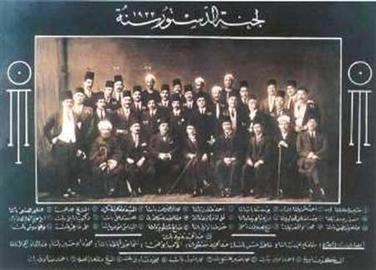
Committee that drafted Egypt's 1923 Constitution

As I regard the final list of the 100 members of Egypt's Constituent Assembly and the dominance of two hegemonic political powers over it, I cannot help but experience a bitter feeling. All I can see is another potential glorious moment squandered for a nation in desperate need for one.

Whereas I remain mindful of the well-deserved dominance of the FJP and Al-Nour over parliament, as well as their right to exercise their earned position on policy issues as the majority in Parliament, I remain staunch in my conviction that the Constituent Assembly and Egypt's next constitution are matters that transcend parliamentary seating distributions.

This constitution is set to represent all of Egypt. It is hoped to be a perfect document, though a constitution never is, and amendments will always take place by force of time and evolution, trial and error. But it was vehemently critical that this constitution of all constitutions carries the equal weight of Egypt's entire political spectrum behind it.

First, this should be the first free constitution to be drafted in the history of Egypt. While I do accept that SCAF's reign tarnishes the "freedom" of this constitution, yet this Constitution has the chance to become the pure work of democratically-elected Egyptian hands, and not colonial, monarchical, and other expressly dictatorial forces. Even further, this constitution will be drafted after a revolution that was the first of its kind for the nation, in which countless lives were sacrificed, and continue to be, for this honour and right as citizens of this nation. Perhaps it might not end up being an entirely freely-drafted constitution, but it should at least end up being our freest ever.

Second, most of the parties which had participated in the parliamentary elections were new parties that had been founded less than one year ago, whose members and candidates did not have sufficient-to-any electoral experience, and/or did not have the ground network or finances that would allow them to campaign effectively. As a result, while FJP and Al-Nour would have probably dominated either way, the weight of such a dominance could have significantly been different had the new parties been better prepared. I accept that these past words might stench with the phrase "sore loser" indeed, but I am genuine in my convictions.

There was a political phase in Egypt right after the revolution that I refer to as "Post-Revolution Politics", characterised by a greater non-partisan rhetoric, and more active and sincere efforts at national reconciliation, coalition building, and group decision making. This was the form of politics we needed to see in this Constituent Assembly and in the deliberative and procedural processes leading to it. Instead, we ended up witnessing the uninspiring conduct of standard "Party Politics", wherein each side tries to get as much as what they can. It was both too early for that, and hardly the occasion for it as well. I realise the naiveté of the idealism of what I am writing, but revolutions are founded upon a degree of idealism, naive or belligerent. And, well, we actually did just have a revolution.

While there are many respectable and undebatable names on the final list of members of the Constituent Assembly, I reiterate once more that all elements of the political spectrum should have had more equal representation in this grouping of men and women drafting the future of Egypt. This was my position in February of 2011 right after the revolution, remained my position in the October right before the elections, and continues to be my position as I write these words at this moment in time.

And while we're on the subject of "men and women drafting the future of Egypt," there should have been more women.


Wednesday, 17 August 2011

Abridged Version Of Egypt's "Basic Constitutional Principles Charter"


Egyptian daily Al Masry Al Youm released an "abridged version" of the proposed "Basic Constitutional Principles Charter". I'm mirroring it here on the blog as I do with all important documents, again for easy future access and documentation. The full Arabic version can also found here. As a reminder, the document has been unanimously approved by all major political forces, including the Muslim Brotherhood, except for the Salafi movements & parties, as well as the Al-Adl (Justice) Party. However, even the approving forces also refuse that the charter becomes part of a new Constitutional Declaration by SCAF.

Original Link for this document, with commentary by the newspaper and readers is here: http://www.almasryalyoum.com/en/node/486431

I also wrote a previous note on the issue here, before the charter was actually released, and while everything was simply a matter of speculation, including the possibility of a full Turkey-inspired role for the Army as a "Guardian" of the "Civil State."


The Democratic Alliance

Al Masry Al Youm translates and abridges the Charter as follows:


Basic Principles:
  1. The Arab Republic of Egypt is a civil democratic state based on citizenship and the rule of law, and respects pluralism, and guarantees freedom, justice, and equality, and provides opportunities to all citizens without discrimination. The Egyptian people are part of the Arab nation, and work for achieving its comprehensive unity.
  2. Islam is the state religion, the Arabic language is its official language, and Islamic Sharia is the primary source of legislation. Non-Muslims resort to their own laws in regards to their personal issues and religious affairs.
  3. Sovereignty is given to the people alone, and they are the source of authority, which they exercise through referendums and fair elections…
  4. The political system for the democratic republic is based on balance of power between various branches of government and the peaceful transfer of power, and the multiplicity of political parties and their establishment by notification…
  5. The national economy is based on comprehensive and sustainable development, which aims to achieve social well-being and fulfill citizens’ most basic needs, promote investment, protect free competition, prevent harmful monopolistic practices, protect the consumer, and guarantee that the benefits of economic growth are fairly distributed to the citizens. The state commits to protecting public property under its supervision, along with its wealth, national resources, lands, and national heritage, in both the material and moral sense…
  6. The state alone may establish the armed forces, which is the people’s property, and whose role is to protect the country’s security and independence, along with its unity and sovereignty over all its land. It is forbidden for any federation, group, or party to create military formations or anything resembling them.
Rights and General Freedoms:
  1. Human dignity is every person’s genuine right, and all Egyptian citizens are free and equal before the law in rights and freedoms and general obligations. Discrimination among them due to sex, origin, language, religion, creeds, wealth, social status, political views, or disabilities or anything of that sort is forbidden.
  2. The state guarantees freedom of belief, worship, and religious slogans and protects the role of worship.
  3. Egyptian nationality is a genuine right of all citizens and stripping citizenship or exiling any Egyptian from his country or preventing him from returning is forbidden, except in the case of a justified judicial ruling.
  4. Freedom of conscience, expression and the media are guaranteed, so long as they do not violate the sanctity of individuals’ private lives, the rights of others, and the fundamentals of Egyptian society. Sabotaging the media, or censoring it or its sources, is forbidden, except as a result of a justified judicial decision, and for a limited period.
  5. Every human being has the right to uncover, transfer, and publish information and participate in cultural and artistic life in all its forms. The state guarantees the freedom of academics, scientific research, imagination, and innovation, and guarantees the independence of universities and scientific research centers.
  6. Every human has the right to enjoy the sanctity of his private life, correspondence, telephone conversations and electronic messages and other forms of communication. Arresting, searching, detaining, confining him, or restricting his personal freedom is forbidden, except with prior judicial order… Except in cases of crimes pertaining to the armed forces, civilians may not be tried in front of any exceptional or military court.
  7. Private property is protected, except in case of judicial ruling and in exchange for fair compensation…
  8. The right to work is guaranteed. The state strives to provide work opportunities to every citizen with the condition of fairness without discrimination, and commits itself to setting a minimum wage to guarantee the citizen human dignity and an appropriate standard of living. Every citizen has the right to assume a public post as long as he is qualified for the position.
  9. Every citizen has the right to a secure life, a pollution-free environment, proper nutrition, habitation, healthcare, exercise, as well as insurance against unemployment, sickness and old-age in accordance with the requirements of justice and social solidarity.
  10. The citizen has a right to an education, and the state commits to providing educational opportunities in its educational institutions for free …
  11. The citizen has the right to set up syndicates, unions, groups, and civil foundations, and they have the right to assemble and demonstrate peacefully without prejudicing the rights of others or the basic rights, principles, or freedoms written in this document.
Translated from the Arabic Edition
End of quotation...